
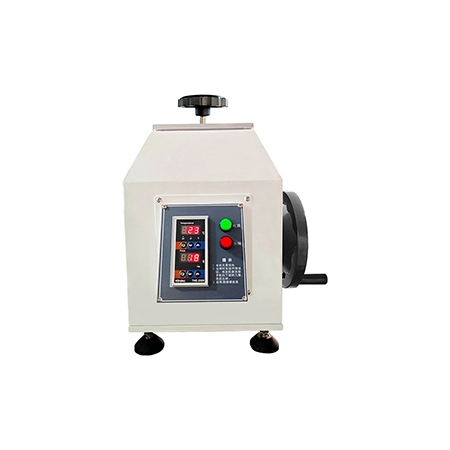
Product photography / image presentation, not a live operation
Mounting presses
XQ-2B
Manual metallographic mounting press
The XQ-2B is a mechanical hot-mounting press for small or irregular metallographic specimens, with digital temperature control and a timed alarm.
TECHNICAL DATA
Technical specifications
Specifications are compiled from published references. Confirm configuration, options and delivery requirements with an engineer.
| Parameter | Specification / configuration |
|---|---|
| Model | XQ-2B |
| Machine body | Benchtop |
| Mounting chamber | Single mounting chamber |
| Mounting method | manual |
| Pressure loading and release | manual |
| Temperature control | automatic |
| Specimen lift | manual |
| Cooling method | Natural cooling |
| End of preparation | Audible buzzer |
| Mounting size | Choice of Φ25mm, Φ30mm or Φ40mm |
| Heater specification | Φ25/Φ30mm:650W;Φ40mm:800W |
| Temperature adjustment range | Room temperature -300℃ |
| Timer | 0-99 min |
| Power supply | 220V |
| Dimensions | 320 * 280 * 420mm (L * W * H) |
| Net weight | 22KG |
| Gross weight | 32kg |
| Standard configuration | |
| Main unit | 1 unit |
| Mounting mold | 1 set |
| Mounting material | 1 container (500mL) |
| Power cable | 1 piece |
| Technical documents | 1 set (manual, warranty card and inspection certificate) |
Specifications checked 2026-11-12 based on the archived public product page.
Working principle
How mounting works
The specimen sits in a mould; resin flows and cures under heat and pressure, encasing thin or irregular parts and their edges in a regular cylinder for grinding.
- Hot or cold per material
- Vacuum impregnation
- Edge support
Product overview
An external handwheel drives bevel gears and a lead screw to move the lower mould within the steel sleeve. The specimen and thermosetting plastic are formed under heat, while an internal spring compensates the mounting pressure and an indicator lamp shows the pressure condition. The machine includes a digital temperature controller, thermocouple, time setting and buzzer. Mounted specimens can then be ground, polished and examined microscopically.
Understand the instrument in context
Select the instrument together with the material, specimen dimensions, target surface and downstream inspection task.
Explore preparation workflows →Questions before selecting
What specimen information should I provide?
Provide material, geometry, dimensions, target cross-section, batch size, current method and the problem to solve.
Are these specifications the final configuration?
The page supports preliminary selection. Confirm fixtures, consumables, power supply and optional features in the technical proposal.
Can I view an instrument demonstration?
The viewer supports image sequences, animated images and video. Image sequences show appearance and structure; refer to validated videos or instructions for operation.