
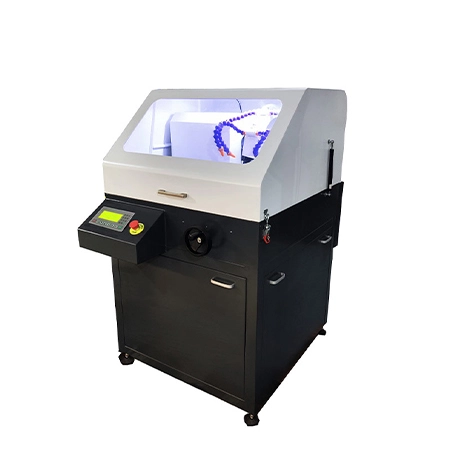
Product photography / image presentation, not a live operation
Cutting machines
2026-11-14 16:15:56
The QG-100Z is a high-performance floor-standing metallographic cut-off machine with a screen-displayed PLC system, simple operation and strong capability. Spindle speed is 2840 r/min, maximum cutting diameter reaches 100 mm, the cutting table measures 300 × 280 mm, and the cutting speed is steplessly adjustable from 1–50 mm/min with a limit of 99 mm/min. The automatic circulating coolant system protects the specimen from burning during cutting.
TECHNICAL DATA
Technical specifications
Specifications are compiled from published references. Confirm configuration, options and delivery requirements with an engineer.
| Parameter | Specification / configuration |
|---|---|
| Model | QG-100Z |
| Control system | Buttons |
| Door opening | Front-opening |
| Spindle speed | 2840 r/min |
| Table X travel | Manual, 50 mm |
| Clamping table | Split platform |
| Table Y travel | Manual, 250 mm |
| Max cut capacity | 130 × 380 × 100 mm |
| Cutting mode | Manual |
| Effective feed distance | Max 220 mm, freely set |
| Cutting table size | 250 × 300 mm |
| Cutting speed | Manual |
| Feed mode | Manual |
| Return mode | Manual |
| Feed rate | Manual |
| Progress display | — |
| Max wheel size | Ø350 × 2.5 × Ø32 mm |
| Cooling system | Automatic, 4-channel water cooling |
| Coolant tank | 60 L |
| Motor power | 4.0 kW |
| Frame | Floor-standing |
| Power supply | 380 V |
| Dimensions | 850 × 950 × 1350 mm (L × W × H) |
| Net weight | 300 kg |
| Gross weight | 350 kg |
Specifications checked 2026-11-12 based on the archived public product page.
Source notes
Source differences are recorded in the Chinese specification notes; confirm the configuration before ordering.
Working principle
How precision sectioning works
A rotating cut-off wheel advances into the specimen under flood coolant, keeping heat and deformation low enough to preserve the true section.
- Wheel matched to material
- 4-channel coolant
- Low feed rate protects edges
Product overview
Product overview
A metallographic cut-off machine is used to take test specimens. Improper sectioning makes later examination meaningless, so choosing a suitable cutter matters. Select the machine mainly by the size of the workpiece: small parts suit cutters with a small cutting capacity, while larger workpieces require a larger capacity. Match the cut-off wheel to the material for a clean, burn-free cut.
Applications
Metallographic cut-off machines are widely used in the following areas:
1. Metal processing and quality control: precise sectioning of steels and non-ferrous metals to prepare specimens for microstructure analysis, quality control and defect inspection.
2. Aerospace: sectioning high-precision parts such as aircraft and rocket engine components to verify that their microstructure meets requirements.
3. Automotive manufacturing: sectioning body and engine components, supporting material selection and durability engineering.
4. Research and teaching: an essential laboratory instrument in institutes and universities for materials research, structure analysis and teaching experiments.
5. Petrochemical and power industries: sectioning pipes, tanks and similar equipment during maintenance and material inspection.
6. Tooling and die making: precise sectioning that supports efficient, high-quality die manufacturing.
7. Electronics and precision manufacturing: component testing and sectioning of ceramics and semiconductor materials.
8. Other fields: construction, bridges and shipbuilding; mineralogy for constituent and particle analysis; and biomedical sampling.
Understand the instrument in context
Select the instrument together with the material, specimen dimensions, target surface and downstream inspection task.
Explore preparation workflows →Questions before selecting
What specimen information should I provide?
Provide material, geometry, dimensions, target cross-section, batch size, current method and the problem to solve.
Are these specifications the final configuration?
The page supports preliminary selection. Confirm fixtures, consumables, power supply and optional features in the technical proposal.
Can I view an instrument demonstration?
The viewer supports image sequences, animated images and video. Image sequences show appearance and structure; refer to validated videos or instructions for operation.