
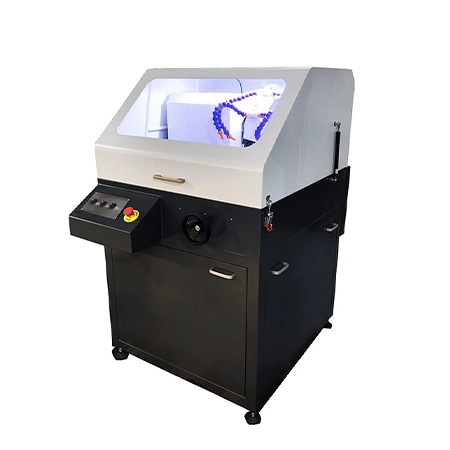
Product photography / image presentation, not a live operation
Cutting machines
QG-5A
Manual metallographic cutting machine
The QG-5A is a manual metallographic cutter with a floor-standing structure, recirculating cooling and a movable positioning platform.
TECHNICAL DATA
Technical specifications
Specifications are compiled from published references. Confirm configuration, options and delivery requirements with an engineer.
| Parameter | Specification / configuration |
|---|---|
| Model | QG-5A |
| Control system | Push buttons |
| Door opening | Front-opening lid |
| Spindle speed | 2840r/min |
| X table movement | / |
| Clamping table | Fixed table |
| Y travel | manual (250mm) |
| Maximum cutting dimensions | 130*380*100mm |
| Cutting modes | manual |
| Effective travel | Up to 220mm (adjustable) |
| Cutting table dimensions | 200*300mm |
| Cutting speed | manual |
| Feed method | manual |
| Reset method | manual |
| Feed rate | manual |
| Cutting progress display | / |
| Maximum wheel dimensions | φ350*2.5*φ32mm |
| Cooling system | Automatic water cooling, 4 channels |
| Tank capacity | 60L |
| Motor power | 4.0KW |
| Machine configuration | Integrated floor-standing unit |
| Power supply | 380V |
| Dimensions | 850*950*1350mm (L * W * H) |
| Net weight | 300KG |
| Gross weight | 350KG |
Specifications checked 2026-11-12 based on the archived public product page.
Working principle
How precision sectioning works
A rotating cut-off wheel advances into the specimen under flood coolant, keeping heat and deformation low enough to preserve the true section.
- Wheel matched to material
- 4-channel coolant
- Low feed rate protects edges
Product overview
The QG-5A combines manual cutting with automatic coolant circulation. Its split, two-level movable positioning platform supports both individual positioned cuts and successive positioned cuts. This arrangement is intended for taking specimen blocks and slices from different workpieces. Suitable specimen materials include metals, ceramics, rocks and electronic components, covering precision sampling tasks where the cut must be placed to suit the specimen.
Understand the instrument in context
Select the instrument together with the material, specimen dimensions, target surface and downstream inspection task.
Explore preparation workflows →Questions before selecting
What specimen information should I provide?
Provide material, geometry, dimensions, target cross-section, batch size, current method and the problem to solve.
Are these specifications the final configuration?
The page supports preliminary selection. Confirm fixtures, consumables, power supply and optional features in the technical proposal.
Can I view an instrument demonstration?
The viewer supports image sequences, animated images and video. Image sequences show appearance and structure; refer to validated videos or instructions for operation.